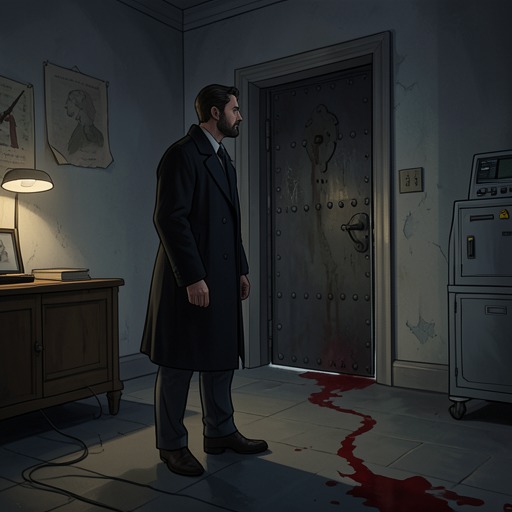
Helga Denningsen
Der goldene HandschuhHelga Denningsen is a cleaner and the wife of Erich Denningsen whose friendship with Fiete Honka becomes a test of the difference between intimacy and possession. She welcomes Fiete into convivial evenings, shares her worries with him, and comforts him when he recounts a brutal episode from his past. He treats these gestures as proof that she wants him, however, and ultimately forces himself on her. Helga’s decisive act in their story is to fight him off and leave.
Identity and Circumstances
Helga works after business hours cleaning the offices where Fiete is employed as a night watchman. The two first meet in that workplace through her visits with Erich, and Fiete sees their shared connection to the building as a bond: she cleans it, he guards it. He uses that resemblance to imagine that she is especially suited to him, even though it says nothing about what she wants.
Her home life is under financial strain. In a private conversation with Fiete, she says she had dreamed of doing something other than cleaning offices and worries that her small wages, combined with Erich’s unemployment benefit, will not be enough to pay off their house. Her concern is specific and practical; Fiete hears it but does not know whether she wants advice or simply someone to listen. The contrast between her expressed difficulties and his self-absorbed interpretation of her attention defines much of their relationship.
Workplace Gatherings and Fiete’s Expectations
On Helga’s birthday, July 13, Erich visits her at work and invites Fiete to join them. Fiete initially refuses alcohol, but gives in to beer and brandy. The three drink, play dice, joke, and listen to music on a portable radio. The evening is lively, and Fiete’s rule against drinking while on duty gives way to an exception that he soon struggles to contain: the next night he cannot resist the alcohol left behind. His relapse belongs to his own dependence, not to any encouragement from Helga, but the gathering marks how quickly he turns shared sociability into a private fantasy of closeness.
Fiete’s birthday on July 31 brings another celebration at work. A marble cake bears five or six lit candles, and Helga takes one of his large hands between her smaller hands and squeezes it while wishing him well. Erich joins in the birthday wishes. The evening continues with beer, brandy, dice, jokes, and music from the radio; the three dance together, and Erich kisses Fiete on the mouth in a burst of enthusiasm. Fiete is moved to tears by the celebration. Erich also invites him to visit their home in Tonndorf. Helga’s warmth is real, but the scene offers no evidence that it is a declaration of romantic interest. Fiete nevertheless imagines that her clothes and attention are meant for him.
Confidence, Disclosure, and Misreading
Erich begins visiting the workplace more often and eventually tells Fiete that he is temporarily unemployed. Fiete takes this as a reason to feel superior to him and judges him for having broken his legs three times. He also concludes, without confirmation from Helga, that she is ready to leave her husband for him. During dice games he reads her looks as secret signals and treats Erich’s failure to notice them as proof of his own interpretation.
When Helga is alone with him, she asks for a glass of grain liquor, then another, and eventually explains what is troubling her: she had hoped for a different life and fears that she and Erich cannot afford their house. Fiete cannot tell whether she wants counsel or a listener. He says little, and they drink in silence. Her decision to confide in him does establish trust, but he folds that trust into a pre-existing sexual expectation. He notices her body and longs to touch her, while persuading himself that her openness means the rest will happen naturally.
Helga also asks why Fiete came to Hamburg and what he had done before. He is struck by the personal question, which is unusual for him; he is accustomed to having to force his way into conversation. He tells her that in 1951, at sixteen, he fled the East Zone and entered the service of Bauer Frerk in Billwerder. Frerk beat him every day with fists, clubs, and a manure fork. After two months Fiete escaped on Frerk’s old bicycle, but police returned him to the farm. Frerk then left him gravely injured, with a fractured skull, lost upper teeth, and wounds on his thighs, without summoning medical help. Fiete was found twenty-five hours later and spent three months at Ginsterhof Hospital; his nose and teeth were never properly repaired.
Tenderness and Assault
As Fiete tells this history, he becomes exhausted and cannot hold back his tears. Helga gently strokes his back. The touch is profoundly moving to him: he has not been touched in this way by a woman for a long time, and he experiences the comfort as more valuable than sex. Helga stays with him for a short while, then says goodbye with good wishes. Her kindness is a moment of care, not consent. Once she has left, Fiete recasts the encounter as a missed sexual opportunity and blames himself for not making a move.
The following day Erich returns. Fiete resents him, imagining that he is useless to Helga and should be looking for work instead of eating food he has brought to the office. When Erich goes out to buy shashlik and chips, Fiete treats his absence as a final chance. Helga mentions that her sister Erika will visit at the weekend because she is often alone after separating from her husband. Fiete interprets this ordinary disclosure as a hint that Helga herself wants to separate and be with him. He waits, counting to sixty and telling himself that if Erich has not returned by then, he will act.
Fiete’s opening is an abrupt declaration of desire. He grabs at Helga’s blouse, pulling off its buttons and damaging her bra, then gropes her breasts. Helga cries out in fear and pain and strikes him until he lets go. She tears herself free and runs away. Fiete is too drunk to pursue her. His immediate fear is that she will go to the police, costing him his job and sending him to prison; he locks the office door from inside and drinks more. The episode ends not with reconciliation but with his drinking and his sense that everything is over.
Narrative Role and Significance
Helga is not presented as confirming the romance Fiete imagines. She initiates conversation, shares anxieties, asks about his past, and offers comfort; these are meaningful acts of attention, but the story keeps them distinct from sexual invitation. Fiete repeatedly converts them into evidence for a fantasy in which she is already leaving Erich and moving toward him. Her assault makes the gap between his interpretation and her agency unmistakable: when he acts on that fantasy, she resists and escapes.
The scenes also place Helga’s everyday constraints beside the masculine performance surrounding her. She speaks of low-paid work and the difficulty of paying a mortgage, while Fiete turns her body and her marriage into measures of his imagined entitlement. Even his moment of genuine gratitude for her tenderness cannot protect her from that entitlement. Her refusal, expressed through resistance and flight rather than a negotiated resolution, is the final fact of their relationship in the supplied narrative.